Not the full picture. Built from public records, which leave things out.Read by hand, Oct 2026DetailsThis is built from public records, which leave a lot out, and some of it may be wrong or out of date. Check the sources, and tell us if you spot a mistake. What this site can't tell you Read by hand. We read Lake of Bays's own documents for this site in October 2026; the Sources page lists which ones. The comparisons with other places still come from the Province's yearly reports.
Questions · 8 so far
Things worth asking about
We read Lake of Bays' financial reports and meeting minutes, and compared its numbers with 51 similar Ontario towns. These are the things that stood out.
What these are, and what they are not. A question here means a number or practice is unusual, or harder to see than it should be. It does not mean anyone did anything wrong. Most unusual numbers turn out to have ordinary explanations, and every question lists some. The only way to know is to ask.
Needs an answer
Needs an answer
These are unusual enough that residents deserve a clear answer from council.
Lake of Bays spent $1.4M on running the town office in 2019 and $2.5M in 2024. Prices only went up about 18% in that time. Only 4 of 51 similar towns had faster growth here.
Found automatically from the town's financial reports · 3 sources
Worth asking
Worth asking
There may well be a good reason. It is still worth asking what it is.
9.06%tax rate increase approved for 2024, against a ten-year average of 2.99% a year
In March 2023 the Township said its tax rate had risen "on average 2.99 per cent annually over the past 10 years". Its own releases then give 6 per cent for the 2023 levy, 9.06% for the 2024 tax rate and 4.27% for the 2026 tax rate. These are different measures (levy against rate), and we did not find the 2025 figure on the pages we could read. All three are above 2.99%.
Found by reading the town's own documents · 3 sources
In 2024, Lake of Bays collected $719K more in its own property tax than in 2023. That is a 11% jump, while prices went up about 2.4%. Only 9 of 51 similar towns raised theirs by more. Almost all of it came from a higher tax rate (up 9% for homes); the value of homes on the tax roll grew only 1.5%.
Found automatically from the town's financial reports · 4 sources
Towns keep savings (called reserves) to pay for new trucks, roof repairs and surprises. Lake of Bays had $4.1M saved at the end of 2024, up from $2.1M in 2019. That is 40% of one year's spending. Only 10 of 51 similar towns had less, compared with what they spend.
Found automatically from the town's financial reports · 2 sources
4.27%municipal tax rate increase in the adopted 2026 budget, against 5.56% for the levy in the draft
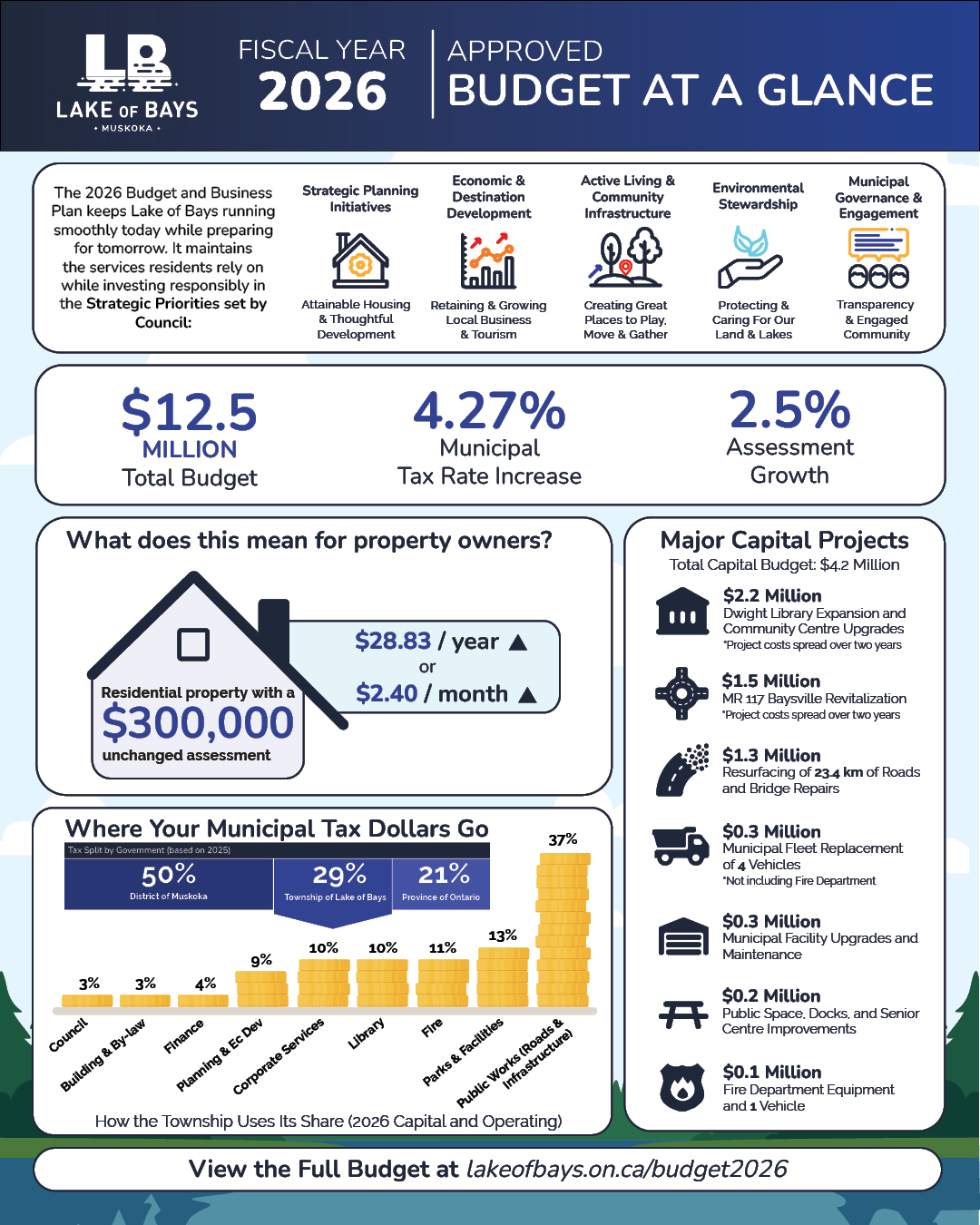
In October 2025 the Township said its draft 2026 budget "includes a 5.56% tax levy increase". On December 9, 2025 council adopted a revised budget that, in the Township's words, lowers "the municipal tax rate increase to 4.27 percent". The budget summary image also shows 2.5% assessment growth. A levy is the total tax money raised, and a rate is applied to every property's value. By our own rough arithmetic (worked out by us), a 4.27% rate increase on 2.5% more assessment would raise the dollar levy by about 6.9% (worked out by us: 1.0427 x 1.025 = 1.0688). If so, the adopted levy increase is not lower than the draft's 5.56%. We cannot tell, because the draft and the adopted budget documents are on the portal we could not read.
Found by reading the town's own documents · 3 sources
The Township's 2026 budget release says the budget includes new fire service staffing "to support the Township's transition to an independent fire department". The budget summary image says the Township spends 11% of its share of tax dollars on fire. We did not find the cost of the transition, or what it replaces, in any page we could read.
Found by reading the town's own documents · 3 sources
Council approved a Municipal Accommodation Tax of 4% on stays in hotels, motels, bed and breakfasts and short-term rentals, starting January 1, 2026. Half of the money goes to a new independent destination marketing organization and half stays with the Township. The first payment from accommodation providers was due April 30, 2026. We did not find a report of how much was collected.
Found by reading the town's own documents · 1 source
Each question in full
Needs an answerFound automatically from financial reports
Lake of Bays spent $1.4M on running the town office in 2019 and $2.5M in 2024. Prices only went up about 18% in that time. Only 4 of 51 similar towns had faster growth here.
Why did the cost of running the town office grow 74% in 5 years?
Running the town office
Prices (inflation)
+0%+20%+40%+60%+80%
+74%
201920202021202220232024
Show as a table
Year
Running the town office
Prices (inflation)
2019
+0%
+0%
2020
+6%
+1%
2021
+41%
+4%
2022
+34%
+11%
2023
+58%
+16%
2024
+74%
+18%
Change since the first year shown. The grey line is how much prices rose overall, for comparison.
Why it matters
Money spent running the office is money not spent on roads, water or safety. When office costs grow much faster than the services people see, it is fair to ask what the extra money is buying.
It could be because…
The town added a service, a building or staff that residents asked for.
Costs were moved from another area, so the total did not really change.
Accounting rules changed how costs are sorted.
Large one-time costs, like a study, lawsuit or repair, landed in one year.
Questions you could ask
What did the extra $1.1M a year pay for?
Why did office and administration go from $1.2M to $2.2M?
Was each increase approved by council as a separate decision, or did it happen through the yearly budget?
You can ask during the public part of a council meeting, by writing to the clerk, or by contacting your councillors. How to reach council.
Speak for Lake of Bays?Send us your answer and we will publish it with this question.
The evidence
Running the town office: 2019 $1.4M, 2020 $1.5M, 2021 $2.0M, 2022 $1.9M, 2023 $2.3M, 2024 $2.5M.
9.06%tax rate increase approved for 2024, against a ten-year average of 2.99% a year
In March 2023 the Township said its tax rate had risen "on average 2.99 per cent annually over the past 10 years". Its own releases then give 6 per cent for the 2023 levy, 9.06% for the 2024 tax rate and 4.27% for the 2026 tax rate. These are different measures (levy against rate), and we did not find the 2025 figure on the pages we could read. All three are above 2.99%.
Why it matters
Taxes that grow faster than inflation and faster than the Township's own history deserve a plain explanation. The Township also says it has one of the lowest residential tax rates in Muskoka, so part of the answer may be catching up.
It could be because…
Inflation and construction costs rose sharply in 2023 and 2024, as the Township's releases say.
The Township's rates started low, so catching up may be a choice council made.
New services, such as an independent fire department, add costs.
The 2025 increase may have been lower, and the average may have fallen.
Questions you could ask
What was the tax rate increase for 2025, and what is the average over the last ten years now?
How much of the recent increases pays for new services and how much for rising costs of existing ones?
You can ask during the public part of a council meeting, by writing to the clerk, or by contacting your councillors. How to reach council.
Speak for Lake of Bays?Send us your answer and we will publish it with this question.
The evidence
The release says the 2023 budget "has a net levy of $6,378,496, representing a 6 per cent increase in the tax levy, resulting in an additional $32.88 in taxes for a property assessed at $300,000". It also says "The tax rate in Lake of Bays has increased on average 2.99 per cent annually over the past 10 years."
The release says the 2024 budget "contains a 9.06% tax rate increase over 2023", an estimated increase of "$52.77 per year" for a $300,000 home. It says the Township has "the 2nd lowest residential tax rate in all of Muskoka".
In 2024, Lake of Bays collected $719K more in its own property tax than in 2023. That is a 11% jump, while prices went up about 2.4%. Only 9 of 51 similar towns raised theirs by more. Almost all of it came from a higher tax rate (up 9% for homes); the value of homes on the tax roll grew only 1.5%.
Why did Lake of Bays' property tax go up 11% in 2024?
$0$2.0M$4.0M$6.0M$8.0M
$7.2M
201920202021202220232024
Show as a table
Year
Town property tax
2019
$5.6M
2020
$5.7M
2021
$5.8M
2022
$6.0M
2023
$6.5M
2024
$7.2M
Why it matters
A big one-year jump usually means something changed: a new cost, a service that grew, savings being rebuilt, or a problem from earlier years being paid for now. Residents should be able to see exactly which. Spread across every home, it is about $140 more each year.
It could be because…
Costs the town cannot control went up, such as policing, insurance or county charges.
The town kept taxes too low in earlier years and is catching up.
The town is rebuilding savings or paying for a big project like a bridge or equipment.
Questions you could ask
What were the three biggest reasons for the 2024 increase, in dollars?
Is a similar increase planned for next year?
You can ask during the public part of a council meeting, by writing to the clerk, or by contacting your councillors. How to reach council.
Speak for Lake of Bays?Send us your answer and we will publish it with this question.
The evidence
Town property tax: $6,461,474 in 2023, $7,180,204 in 2024.
Lake of Bays spent $1.2M on police, fire and safety in 2019 and $2.1M in 2024. Prices only went up about 18% in that time.
Why did the cost of police, fire and safety grow 74% in 5 years?
Police, fire and safety
Prices (inflation)
+0%+20%+40%+60%+80%
+74%
201920202021202220232024
Show as a table
Year
Police, fire and safety
Prices (inflation)
2019
+0%
+0%
2020
+5%
+1%
2021
+34%
+4%
2022
+55%
+11%
2023
+75%
+16%
2024
+74%
+18%
Change since the first year shown. The grey line is how much prices rose overall, for comparison.
Why it matters
When one area grows much faster than prices, it is either doing more (which may be great) or paying more for the same thing. Residents deserve to know which.
It could be because…
The town added a service, a building or staff that residents asked for.
Costs were moved from another area, so the total did not really change.
Accounting rules changed how costs are sorted.
Large one-time costs, like a study, lawsuit or repair, landed in one year.
Questions you could ask
What did the extra $904K a year pay for?
Why did building permits go from $494K to $886K?
Was each increase approved by council as a separate decision, or did it happen through the yearly budget?
You can ask during the public part of a council meeting, by writing to the clerk, or by contacting your councillors. How to reach council.
Speak for Lake of Bays?Send us your answer and we will publish it with this question.
The evidence
Police, fire and safety: 2019 $1.2M, 2020 $1.3M, 2021 $1.6M, 2022 $1.9M, 2023 $2.1M, 2024 $2.1M.
Towns keep savings (called reserves) to pay for new trucks, roof repairs and surprises. Lake of Bays had $4.1M saved at the end of 2024, up from $2.1M in 2019. That is 40% of one year's spending. Only 10 of 51 similar towns had less, compared with what they spend.
Does Lake of Bays have enough saved for repairs and emergencies?
$0$1.0M$2.0M$3.0M$4.0M$5.0M
$4.1M
201920202021202220232024
Show as a table
Year
Savings (reserves)
2019
$2.1M
2020
$2.9M
2021
$4.2M
2022
$3.4M
2023
$3.9M
2024
$4.1M
Why it matters
With little saved, a broken bridge or a storm has to be paid for with a sudden tax increase or a loan. Low savings can also mean past budgets were balanced by spending savings instead of facing the real cost.
It could be because…
The town spent savings on purpose, on projects that were planned and saved up for.
Some savings were used to match grant money, which brings in more than it costs.
The town has a plan to rebuild its savings.
Questions you could ask
Does the town have a written reserve policy with a target amount?
What were the savings spent on between 2019 and 2024?
What is the plan to rebuild them, and by when?
You can ask during the public part of a council meeting, by writing to the clerk, or by contacting your councillors. How to reach council.
Speak for Lake of Bays?Send us your answer and we will publish it with this question.
4.27%municipal tax rate increase in the adopted 2026 budget, against 5.56% for the levy in the draft
In October 2025 the Township said its draft 2026 budget "includes a 5.56% tax levy increase". On December 9, 2025 council adopted a revised budget that, in the Township's words, lowers "the municipal tax rate increase to 4.27 percent". The budget summary image also shows 2.5% assessment growth. A levy is the total tax money raised, and a rate is applied to every property's value. By our own rough arithmetic (worked out by us), a 4.27% rate increase on 2.5% more assessment would raise the dollar levy by about 6.9% (worked out by us: 1.0427 x 1.025 = 1.0688). If so, the adopted levy increase is not lower than the draft's 5.56%. We cannot tell, because the draft and the adopted budget documents are on the portal we could not read.
Why it matters
Residents compare the draft and the final number to see what council cut. If the two numbers measure different things, the cut is hard to see.
It could be because…
The draft's "tax levy increase" may have meant the tax rate increase, and the wording may be loose.
The levy dollars and the rate can differ because new buildings add to assessment.
The 2.5% assessment growth may be an early estimate.
Questions you could ask
What was the dollar levy in the draft 2026 budget and in the adopted one?
Was the draft's 5.56% a levy increase or a tax rate increase?
You can ask during the public part of a council meeting, by writing to the clerk, or by contacting your councillors. How to reach council.
Speak for Lake of Bays?Send us your answer and we will publish it with this question.
The evidence
The release says "The proposed budget includes a 5.56% tax levy increase."
The release says council "directed staff to return with options to reduce the overall levy impact" and that the revised budget "lowers the municipal tax rate increase to 4.27 percent". For a $300,000 home, "an increase of $28.83 per year on the municipal portion of the tax bill".
The image shows "$12.5 MILLION Total Budget", "4.27% Municipal Tax Rate Increase" and "2.5% Assessment Growth", and "$28.83 / year" or "$2.40 / month" for a residential property with a $300,000 unchanged assessment.
The Township's 2026 budget release says the budget includes new fire service staffing "to support the Township's transition to an independent fire department". The budget summary image says the Township spends 11% of its share of tax dollars on fire. We did not find the cost of the transition, or what it replaces, in any page we could read.
Why it matters
A new municipal service is a lasting cost. Residents can weigh it only if the Township says what it costs each year and what it replaces.
It could be because…
The Township may have been paying another body for fire service, and ending that cost may offset the new one.
The full budget on the portal may set out the cost, which we could not read.
An independent service may give faster local response, which the Township says is the aim.
Questions you could ask
What does the independent fire department cost per year, and what does it replace?
Is there a published plan showing when the transition ends and what it costs in total?
You can ask during the public part of a council meeting, by writing to the clerk, or by contacting your councillors. How to reach council.
Speak for Lake of Bays?Send us your answer and we will publish it with this question.
The evidence
The release lists "new fire service staffing to support the Township's transition to an independent fire department" among the 2026 budget highlights.
The "Where Your Municipal Tax Dollars Go" chart shows Fire at 11% of the Township's share for 2026 capital and operating. The nine shares printed on the chart add to 100% (worked out by us).
Council approved a Municipal Accommodation Tax of 4% on stays in hotels, motels, bed and breakfasts and short-term rentals, starting January 1, 2026. Half of the money goes to a new independent destination marketing organization and half stays with the Township. The first payment from accommodation providers was due April 30, 2026. We did not find a report of how much was collected.
Why it matters
Half of a new tax is handed to an outside group. Residents can only follow the money if the Township reports what came in and how each half was spent.
It could be because…
The 2026 budget may count the expected revenue, and a report may come with the year-end statements.
The first year is a start-up year, so reporting may be set up later.
Questions you could ask
How much accommodation tax did the Township collect in its first quarters, and how much went to the destination marketing organization?
Where will the Township publish the yearly total and how the organization spent its half?
You can ask during the public part of a council meeting, by writing to the clerk, or by contacting your councillors. How to reach council.
Speak for Lake of Bays?Send us your answer and we will publish it with this question.
The evidence
The release says a "four percent (4%) MAT" applies from January 1, 2026. "Half of all MAT proceeds will be managed by a newly established independent Lake of Bays Destination Marketing Organization" and "The remaining fifty percent (50%) of revenue will be retained by the Township". It says "The first deadline for remittance is April 30, 2026."
Can we count your visit? With your OK, we use Google Analytics to see which pages help people. It sets cookies and sends visit data to Google. Nothing loads unless you say yes. Privacy