Not the full picture. Built from public records, which leave things out.Read by hand, Oct 2026DetailsThis is built from public records, which leave a lot out, and some of it may be wrong or out of date. Check the sources, and tell us if you spot a mistake. What this site can't tell you Read by hand. We read Tweed's own documents for this site in October 2026; the Sources page lists which ones. The comparisons with other places still come from the Province's yearly reports.
Questions · 21 so far
Things worth asking about
We read Tweed's financial reports and meeting minutes, and compared its numbers with 73 similar Ontario towns. These are the things that stood out.
What these are, and what they are not. A question here means a number or practice is unusual, or harder to see than it should be. It does not mean anyone did anything wrong. Most unusual numbers turn out to have ordinary explanations, and every question lists some. The only way to know is to ask.
Needs an answer
Needs an answer
These are unusual enough that residents deserve a clear answer from council.
Towns keep savings (called reserves) to pay for new trucks, roof repairs and surprises. Tweed had $3.5M saved at the end of 2024, down from $5.7M in 2019. That is 36% of one year's spending. Only 6 of 73 similar towns had less, compared with what they spend.
Found automatically from the town's financial reports · 4 sources
Worth asking
Worth asking
There may well be a good reason. It is still worth asking what it is.
$182,736spent in 2025, against a revised budget of $40,000
For 2025, the town budgeted $40,000 for lawyers and other professionals in its main office. By April 15, 2026, it had spent $182,736. For 2026, it has budgeted $242,900, six times the 2025 plan, plus $40,000 for legal and professional fees in a new storm water budget. It is the third year running far over budget: $66,323 against $22,500 in 2023, and $134,569 against $22,500 in 2024. The town’s July 2026 report says most of the 2026 money pays for people on contract: a treasurer and a facility manager. It has not said what the 2025 money paid for.
Found by reading the town's own documents · 5 sources
The 2026 budget sets office salaries at $629,434, up from $431,947 in the 2025 budget. The books in April 2026 showed $536,059 spent on salaries in 2025 (the draft year-end says $521,462), so the new budget is also 17% above what was really spent. In 2025, salaries ran over budget, but a $150,000 line for a pay review was mostly unspent, so the two together came in slightly under budget.
Found by reading the town's own documents · 3 sources
0entries in the online registry, checked 2026-09-30
When a council member has a personal stake in a decision, they must declare it and stay out of the discussion and vote. Since 2019, Ontario law says towns must keep a registry of these declarations that the public can inspect. It does not have to be online. The registry on Tweed's meeting portal has no entries, and we could not find one anywhere else online, but the town's own minutes record 41 declarations since 2020, 18 of them by the current council and committee.
Found by reading the town's own documents · 8 sources
The minutes show 8 times since 2020 when a council member stayed out of a decision because a batch of town payments, a staff report or a tender involved a business owned by their family. Most involve one welding business owned by a current councillor's son, which came up at least 6 times between 2020 and 2022 in town payments, staff reports and a tender. Each time, the member declared it and stayed out of the discussion and the vote, which is what the law asks. What residents cannot see is how much these businesses were paid in total, or how they were chosen.
Found by reading the town's own documents · 8 sources
117 of 147council meetings we read had a closed session
Ontario lets councils meet privately for a few reasons, like staff matters, lawsuits or buying land. Tweed's council went behind closed doors at 117 of its 147 council meetings from June 10, 2020 to September 1, 2026. Afterwards, 114 times, it voted in public that "staff follow Council direction from the Closed Meeting", without saying what that direction was.
Found by reading the town's own documents · 8 sources
$60,456spent on the Hannah Street agreement in 2023 and 2024
In 2023 Tweed agreed to take over Hannah Street, a road owned by a private landowner, for its road network. Instead of paying for the land, the town agreed to pay for environmental studies needed to rezone the owner’s other land next door from industrial to housing, pay the owner’s application fees for up to 4 new lots, and waive its own rezoning fee. The town’s books show $60,456 spent in 2023 and 2024, and $7,200 more budgeted for 2026. The same studies also covered a piece of town-owned land nearby.
Found by reading the town's own documents · 5 sources
$1,000the sale price in the 2023 draft agreement, after $16,000 was spent on player equipment in 2021
In 2021 the town started running its own team in the Eastern Ontario Super Hockey League, the Tweed Oil Kings. Council bought $16,000 of player equipment, got a liquor licence to run a bar at home games, and gave the team its own bank account. In late 2023 it sold the team to a private buyer. The draft sale agreement set the price at $1,000, with the team’s equipment, unsold merchandise and unspent sponsorship money going to the buyer. We could not find a report of what the team cost or earned while the town owned it.
Found by reading the town's own documents · 7 sources
Councillor Jacob Palmateer declared a conflict of interest twice in late 2021: once because he was “a current member/player” of the Tweed Oil Kings, and once because he “receives team equipment”. On several other decisions about the team, before and after those declarations, he moved or seconded the motions, including the $16,000 equipment purchase in July 2021 and, in October 2023, the draft sale agreement he was named to help negotiate. The minutes do not say when he joined or left the team.
Found by reading the town's own documents · 7 sources
In 2024, Tweed collected $903K more in its own property tax than in 2023. That is a 19% jump, while prices went up about 2.4%. Only 1 of 73 similar towns raised theirs by more. Almost all of it came from a higher tax rate (up 17% for homes); the value of homes on the tax roll grew only 1.0%.
Found automatically from the town's financial reports · 7 sources
Tweed spent $980K on running the town office in 2019 and $1.7M in 2024. Prices only went up about 18% in that time. Only 11 of 73 similar towns had faster growth here.
Found automatically from the town's financial reports · 4 sources
Tweed spent $718K on parks, arena and library in 2019 and $1.3M in 2024. Prices only went up about 18% in that time. Only 8 of 73 similar towns had faster growth here.
Found automatically from the town's financial reports · 3 sources
At the end of 2024, $1.1M of property tax had been billed but not paid. That is 12% of everything billed. Only 8 of 73 similar towns had a higher share. A year earlier it was $719K.
Found automatically from the town's financial reports · 3 sources
At the end of 2024, Tweed owed $3.7M on temporary loans. That is like putting 34% of a year's income on a line of credit. This is short-term borrowing for building projects, which is normal while waiting for a grant or a long-term loan. But it was already $3.5M a year earlier, so it has lasted more than a year. Only 7 of 73 similar towns had any temporary loans at the end of 2024.
Found automatically from the town's financial reports · 3 sources
50%of the 2025 capital budget spent by April 15, 2026
Capital spending means fixing and building things that last: roads, trucks, pipes, buildings. For 2025, council approved $4,478,798. By April 15, 2026, $2,227,852 had been spent. Grants and loans for capital also came in at 43% of plan. For 2026, council has approved almost the same amount again: $4,438,290.
Found by reading the town's own documents · 3 sources
On July 8, 2026, some residents on the town's pre-authorized tax payment plan had their taxes taken from their bank accounts twice. The Mayor's July 21 message calls it a "software glitch", thanks staff for fixing it and starting to make things right within 24 hours, and says the OPP recognized it was an honest error. Refunds were paid by cheque, available from July 10 on request and July 13 to 15 for everyone else, and the town promised to cover bank fees.
Found by reading the town's own documents · 3 sources
Tweed streams its council meetings on YouTube. Its website says each video stays up only until the minutes are approved. In practice, every regular council meeting since June 25, 2024 is still online. Videos of meetings from 2023 and early 2024 are not.
Found by reading the town's own documents · 2 sources
Every year an outside auditor checks the town’s books, and the town posts the result. Tweed’s records portal has the audited statements for 2009 to 2023. The 2023 ones were signed in May 2024. We could not find the 2024 statements, more than a year later. Staff told council in September 2026 that the 2025 statements should be done by the end of October.
Found by reading the town's own documents · 3 sources
Tweed posts its open tenders on a "Tender Opportunities" page, and says it also buys through two purchasing groups shared with other towns. What we could not find is a record of past tenders: who bid, who won, and for how much. Some awards appear in council minutes, but mostly the bigger ones, and they are hard to find.
Found by reading the town's own documents · 1 source
In 2019, Tweed had $4.3M more in cash and money owed to it than it owed to others. By 2024 it was −$11.2M. About 53% of that change ($8.2M) is a new accounting rule from 2023: towns must now record the future cost of closing things like a landfill. That is not new spending or borrowing. Even leaving that out, only 7 of 73 similar towns are in a weaker position.
Found automatically from the town's financial reports · 2 sources
Towns keep savings (called reserves) to pay for new trucks, roof repairs and surprises. Tweed had $3.5M saved at the end of 2024, down from $5.7M in 2019. That is 36% of one year's spending. Only 6 of 73 similar towns had less, compared with what they spend.
Does Tweed have enough saved for repairs and emergencies?
$0$2.0M$4.0M$6.0M
$3.5M
201920202021202220232024
Show as a table
Year
Savings (reserves)
2019
$5.7M
2020
$5.2M
2021
$5.2M
2022
$4.6M
2023
$3.4M
2024
$3.5M
Why it matters
With little saved, a broken bridge or a storm has to be paid for with a sudden tax increase or a loan. Low savings can also mean past budgets were balanced by spending savings instead of facing the real cost.
It could be because…
The town spent savings on purpose, on projects that were planned and saved up for.
Some savings were used to match grant money, which brings in more than it costs.
The town has a plan to rebuild its savings.
Questions you could ask
Does the town have a written reserve policy with a target amount?
What were the savings spent on between 2019 and 2024?
What is the plan to rebuild them, and by when?
You can ask during the public part of a council meeting, by writing to the clerk, or by contacting your councillors. How to reach council.
Speak for Tweed?Send us your answer and we will publish it with this question.
The town has said the same thing itself. Its 2024 budget presentation: of 52 bridges and large culverts, 32 need significant maintenance, rehabilitation or replacement within 10 years, and it puts the projected cost for 41 of them at $27,190,200 over those 10 years, which it equates to a 49.9% tax increase if paid from taxes alone.
The same presentation projected water and sewer savings of $411,372 at the end of 2023, against $9,906,690 of water and sewer replacements due in the next 10 years, and said Tweed’s water and sewer rates were well below similar towns’.
$182,736spent in 2025, against a revised budget of $40,000
For 2025, the town budgeted $40,000 for lawyers and other professionals in its main office. By April 15, 2026, it had spent $182,736. For 2026, it has budgeted $242,900, six times the 2025 plan, plus $40,000 for legal and professional fees in a new storm water budget. It is the third year running far over budget: $66,323 against $22,500 in 2023, and $134,569 against $22,500 in 2024. The town’s July 2026 report says most of the 2026 money pays for people on contract: a treasurer and a facility manager. It has not said what the 2025 money paid for.
Why it matters
Despite its name, a "legal and professional fees" line can pay for many things: lawyers, consultants, auditors, recruiters, or even staff hired on contract instead of as employees. Residents cannot judge whether the money is well spent, or compare it with salaries, unless the town says what it paid for.
It could be because…
Staff hired on contract rather than as employees. For 2026 the town says this is most of it: a treasurer and a facility manager. The minutes show an interim treasurer in 2025 too.
Consultants for required work, such as an asset management plan, or a recruiting firm to hire senior staff.
Legal advice or a claim against the town.
Integrity Commissioner or closed-meeting investigation costs, which are billed to the town.
Questions you could ask
What were the main items in the $182,736 of legal and professional fees in 2025?
Were the 2025 fees also mostly contract staff? If so, why was the 2025 budget only $40,000?
The 2025 budget mentions “several legal matters” in progress. Without naming anyone, what kinds of matters were they, and are any still open?
What is the extra $35,000 “required for tax” in the 2026 forecast?
How much of it pays for people working for the town on contract, and how does that compare with hiring them as employees?
You can ask during the public part of a council meeting, by writing to the clerk, or by contacting your councillors. How to reach council.
Speak for Tweed?Send us your answer and we will publish it with this question.
Legal and Professional Fees (administration): 2025 revised budget $40,000, actual $182,736 (books as of April 15, 2026); the town's own forecast for the full year is also $182,736; 2026 budget $242,900.
The town's own page, with the line highlighted (slide sideways for the account name). Tap to open it full size.
Earlier years, from the town’s 2025 budget: legal and professional fees were budgeted at $22,500 in 2023 and $66,322.95 was spent; budgeted at $22,500 in 2024 and $134,569.07 was spent (before the audit).
The town’s July 2026 variance report explains the 2026 budget for this line: legal fees $46,400, a facility manager $67,000, the treasurer $122,000 and bank reconciliation $7,500 (together $242,900). It now forecasts $277,900 for 2026, with “additional $35K required for tax”, offset by a vacancy in salaries. $132,128 had been spent by July 31, 2026, and the 2025 year-end total stayed at $182,736.
The 2026 budget sets office salaries at $629,434, up from $431,947 in the 2025 budget. The books in April 2026 showed $536,059 spent on salaries in 2025 (the draft year-end says $521,462), so the new budget is also 17% above what was really spent. In 2025, salaries ran over budget, but a $150,000 line for a pay review was mostly unspent, so the two together came in slightly under budget.
Why it matters
The cost of running the town office has already grown much faster than prices since 2019 (see the question on office costs). Salaries are the biggest piece, and once added they repeat every year.
It could be because…
The results of the pay review: the town set aside $150,000 for a payroll review and pay equity in 2025 and spent $17,555. Raises that come out of a review show up in salaries.
New or refilled positions, such as a treasurer, or overlap while a new person is trained.
Costs moved into this line from elsewhere in the budget.
Questions you could ask
How many people are paid from the office salaries line, and how has that changed since 2024?
What did the 2025 payroll review recommend, and what will it cost each year from now on?
You can ask during the public part of a council meeting, by writing to the clerk, or by contacting your councillors. How to reach council.
Speak for Tweed?Send us your answer and we will publish it with this question.
The evidence
Administration Salaries and Wages: 2025 revised budget $431,947, 2025 actual $536,059, 2026 budget $629,434.
The town's own page, with the line highlighted (slide sideways for the account name). Tap to open it full size.
The town’s July 2026 variance report: office salaries for 2025 finished at $521,462 in the draft year-end. For 2026, $347,828 had been spent by July 31, and the forecast for the year is $584,503, below the budget because of a “staff vacancy”.
0entries in the online registry, checked 2026-09-30
When a council member has a personal stake in a decision, they must declare it and stay out of the discussion and vote. Since 2019, Ontario law says towns must keep a registry of these declarations that the public can inspect. It does not have to be online. The registry on Tweed's meeting portal has no entries, and we could not find one anywhere else online, but the town's own minutes record 41 declarations since 2020, 18 of them by the current council and committee.
Why it matters
The registry is how residents can see, in one place, who has a stake in what. If it is empty, the only way to find conflicts is to read hundreds of pages of minutes, which almost nobody does.
It could be because…
The town keeps the official registry on paper at the town hall, and it can be viewed there. The law allows this.
The online registry is a feature of the meeting software that the town simply has not used.
Questions you could ask
Where is the registry of declarations kept, and how can a resident see it?
Does it include the written statement each member must file for every declaration (section 5.1)?
Can the town turn on the online registry in its meeting software and fill it in from past minutes?
You can ask during the public part of a council meeting, by writing to the clerk, or by contacting your councillors. How to reach council.
Speak for Tweed?Send us your answer and we will publish it with this question.
The evidence
The "Conflicts Registry" on Tweed's meeting portal showed 0 entries on 2026-09-30.
Municipal Conflict of Interest Act, section 6.1: every municipality and local board (including a Committee of Adjustment) must keep a registry of declarations and written statements, available for public inspection in the manner the municipality decides.
The minutes show 8 times since 2020 when a council member stayed out of a decision because a batch of town payments, a staff report or a tender involved a business owned by their family. Most involve one welding business owned by a current councillor's son, which came up at least 6 times between 2020 and 2022 in town payments, staff reports and a tender. Each time, the member declared it and stayed out of the discussion and the vote, which is what the law asks. What residents cannot see is how much these businesses were paid in total, or how they were chosen.
Why it matters
Staying out of the vote is the minimum. The bigger risk in a small town is that work slowly flows to people who are connected, without anyone breaking a rule. Totals and how each job was awarded are what show whether that is happening.
It could be because…
In a small town, the nearest welder or equipment dealer may well be related to someone on council. Using local businesses can be the cheapest option.
The purchases may have been small and made under the town's normal quote rules, by staff, without council involvement.
For the 2021 signage tender, council chose a different company, which suggests the process worked.
Questions you could ask
How much did the town pay each business that a council member has declared a family link to, per year since 2018?
Were those purchases made through quotes or tenders under the procurement policy? Who approved them?
Does the town keep a list of businesses linked to council members and senior staff, so purchasing staff know to take extra care?
You can ask during the public part of a council meeting, by writing to the clerk, or by contacting your councillors. How to reach council.
Speak for Tweed?Send us your answer and we will publish it with this question.
The evidence
August 25, 2020: Councillor J. Flieler. A staff report that mentioned a welding business he has a family relationship to.
117 of 147council meetings we read had a closed session
Ontario lets councils meet privately for a few reasons, like staff matters, lawsuits or buying land. Tweed's council went behind closed doors at 117 of its 147 council meetings from June 10, 2020 to September 1, 2026. Afterwards, 114 times, it voted in public that "staff follow Council direction from the Closed Meeting", without saying what that direction was.
Why it matters
A closed meeting is allowed, but the public should still learn the outcome when it is safe to share. A vote to "follow the direction" tells residents that something was decided, but not what. Repeated often, it makes it hard to hold anyone to account.
It could be because…
Many of these meetings are about staff or lawsuits, where details truly must stay private.
The law allows councils to give directions to staff in a closed meeting.
Small towns often use the same wording every time out of habit.
Questions you could ask
Will the new procedural by-law ask council to report back in public, in general terms, after each closed meeting?
For each closed meeting in the last year, which decisions have since been made public, and where?
Will council report the outcome of closed-session directions once the reason for privacy has passed (for example, after a land sale closes)?
Anyone can ask for a closed-meeting investigation, and Tweed uses Local Authority Services (LAS) as its investigator. Has any request ever been made, and was a report published?
You can ask during the public part of a council meeting, by writing to the clerk, or by contacting your councillors. How to reach council.
Speak for Tweed?Send us your answer and we will publish it with this question.
The evidence
117 of 147 council and special council meetings (2020-06-10 to 2026-09-01) included a closed session. The most-cited reasons were personal matters about an identifiable person, litigation, labour relations and land.
Municipal Act, 2001, section 239: the reasons a meeting may be closed. A vote may be held in private only if the meeting was allowed to be closed, and only on procedural matters or directions to staff and contractors.
The Ontario Ombudsman: "Although there is no requirement under the Municipal Act, 2001 for municipal councils to report back in public after the conclusion of a closed meeting, the Ombudsman recommends this practice to increase transparency of the closed meeting process."
A rewritten procedural by-law (By-law 2026-64) was on the September 29, 2026 council agenda. Its closed-meeting section says only the Mayor or their delegate may release information about a closed meeting, and members are to answer “no comment” until a matter is “reported publicly”. The copy on the agenda does not require council to report back in public after a closed meeting.
$60,456spent on the Hannah Street agreement in 2023 and 2024
In 2023 Tweed agreed to take over Hannah Street, a road owned by a private landowner, for its road network. Instead of paying for the land, the town agreed to pay for environmental studies needed to rezone the owner’s other land next door from industrial to housing, pay the owner’s application fees for up to 4 new lots, and waive its own rezoning fee. The town’s books show $60,456 spent in 2023 and 2024, and $7,200 more budgeted for 2026. The same studies also covered a piece of town-owned land nearby.
Why it matters
Trading services for land can be a good deal for everyone. But residents cannot judge it without knowing what the road was worth, how much of the study money was for the owner’s land rather than the town’s, and what the road will cost to maintain from now on.
It could be because…
The town needed the road for its network, for example to maintain and plow it, and this cost less than buying it.
The studies were needed anyway: they also covered vacant town land on George Street that the town wants to rezone for housing.
Up to four new homes would add to the town’s tax base.
Questions you could ask
What was Hannah Street worth, and did the town get an appraisal before agreeing?
How much of the study cost was for the owner’s land, and how much for the town’s George Street land?
Have the new lots been created, and has building started, as the agreement expects by November 14, 2026?
What will Hannah Street cost the town to maintain each year?
You can ask during the public part of a council meeting, by writing to the clerk, or by contacting your councillors. How to reach council.
Speak for Tweed?Send us your answer and we will publish it with this question.
The records that would answer this can be requested: The Hannah Street agreement, with wording you can copy.
The evidence
The draft agreement: the owner transfers Hannah Street (RP 21R18866 Parts 4 and 5) to the town. In exchange the town will complete Phase 1 and 2 environmental assessments “as required for rezoning”, pay the conservation authority and Hastings County consent fees for up to 4 new residential lots on the owner’s neighbouring land, and waive the rezoning fee from Urban Industrial to residential. The owner agrees to begin development before November 14, 2026.
Staff asked three firms to quote and two replied. Council chose Cambium: Phase 1 at $10,100, Phase 2 at $56,250, and $2,500 per lot for a Record of Site Condition, all plus HST. The other firm quoted $15,150 for Phase 1 and said Phase 2 could cost $10,000 to $100,000. The report says the work covered Hannah Street and vacant municipal land on George Street, and that it was not budgeted until 2024 but the agreement says “time is of the essence”.
$1,000the sale price in the 2023 draft agreement, after $16,000 was spent on player equipment in 2021
In 2021 the town started running its own team in the Eastern Ontario Super Hockey League, the Tweed Oil Kings. Council bought $16,000 of player equipment, got a liquor licence to run a bar at home games, and gave the team its own bank account. In late 2023 it sold the team to a private buyer. The draft sale agreement set the price at $1,000, with the team’s equipment, unsold merchandise and unspent sponsorship money going to the buyer. We could not find a report of what the team cost or earned while the town owned it.
Why it matters
Running a sports team is not a usual job for a town. Residents should be able to see what it cost, what it brought in, and whether selling it for $1,000 with its equipment was the best deal available.
It could be because…
Ticket sales, the bar, 50/50 draws and sponsors may have covered much of the cost; those are not in the budget lines we could see.
The team brought people to the arena and paid ice rental, and the buyer agreed to keep it in Tweed and keep renting the town’s ice.
A team’s main value is its place in the league, so a low price for a small team is common.
Questions you could ask
What did the team cost and earn in each season, including tickets, the bar, 50/50 draws and sponsors?
What were the equipment and the unspent sponsorship money worth when the team was sold for $1,000?
Did the town look for other buyers, and how much has it earned from the team’s ice rental since?
You can ask during the public part of a council meeting, by writing to the clerk, or by contacting your councillors. How to reach council.
Speak for Tweed?Send us your answer and we will publish it with this question.
The evidence
June 9, 2021: council approved the Tweed Oil Kings name and logo and opened a separate bank account for the team.
May 11, 2022: council gave the team’s general manager the right of first refusal to buy the team if it were ever sold. A waiver of that right, dated September 1, 2023, is attached to the 2023 sale agreement.
The 2024 budget presentation lists the team’s 2023 budget: $38,500 for materials, $6,500 for contracted services and $4,750 for rents and financial costs, against $2,000 of other revenue, all gone in 2024 after the sale.
The draft purchase agreement: the buyer pays “ONE-THOUSAND DOLLARS ($1,000.00)”, takes the team’s chattels (equipment), volunteers, player roster and unsold merchandise, receives a summary of unspent sponsorship and advertising money, keeps the team in Tweed, rents the town’s ice, and gives the town a 4-year right to buy the team back.
Councillor Jacob Palmateer declared a conflict of interest twice in late 2021: once because he was “a current member/player” of the Tweed Oil Kings, and once because he “receives team equipment”. On several other decisions about the team, before and after those declarations, he moved or seconded the motions, including the $16,000 equipment purchase in July 2021 and, in October 2023, the draft sale agreement he was named to help negotiate. The minutes do not say when he joined or left the team.
Why it matters
The conflict of interest law asks council members to declare any money interest, stay out of the discussion and not vote. Declaring on some items about a team but not others makes it hard for residents to tell whether the rule was applied the same way each time.
It could be because…
He may not have been on the team at the time of some of these votes: the minutes only show he was a player in October and December 2021.
Not every link to a team is a money ("pecuniary") interest under the law. He declared when equipment he received or the team’s budget was in front of council; other decisions may not have affected him financially.
He may have asked the clerk or the Integrity Commissioner for advice. Only the Integrity Commissioner or a judge can decide whether the law was broken.
Questions you could ask
When was Councillor Palmateer a member of the team, and did he receive anything from it besides equipment?
Did he or the clerk get advice on which team decisions he should declare on?
Does the town give council members written guidance on declaring interests in clubs and teams the town runs?
You can ask during the public part of a council meeting, by writing to the clerk, or by contacting your councillors. How to reach council.
Speak for Tweed?Send us your answer and we will publish it with this question.
The evidence
June 9, 2021: Councillor Palmateer moved the motions to open the team’s bank account and to approve its name and logo.
July 21, 2021 (special meeting): no declarations of interest were recorded (“None”). Councillor Palmateer moved the motion to approve the purchase of team player equipment for $16,000.
July 27, 2021: he moved the motion to let the team sell alcohol at home games. August 24, 2021: his notice of motion to use the team’s 50/50 draw to help charities, with the town’s 3% licensing fee used “to help fund the Tweed Oil Kings”. September 8, 2021: he seconded extending alcohol to the arena seating area after the team’s liquor licence report.
October 13, 2021: “Councillor J. Palmateer disclosed a possible conflict of interest on Agenda Item No. 13.2.2 - Tweed Oil Kings Updated Budget as he is a current member/player for the Tweed Oil Kings”, and left before the item.
December 8, 2021: he declared a conflict on the approval of accounts “as he is a part of the Tweed Oil Kings team and receives team equipment”, and left the room.
March 9, 2022: he seconded the motion letting the Tweed Oil Kings run a bar at the Family Feud hockey weekend. August 23, 2022: he seconded the motion on a proposal to stream the team’s home games.
May 9, 2023: council named Councillor Valiquette and Councillor Palmateer to meet the team’s general manager on its terms of reference. August 8, 2023: he seconded approval of the Tweed Oil Kings Committee terms of reference. October 10, 2023: he moved approval of the draft purchase agreement, with final details to be negotiated by Councillors Valiquette and Palmateer and staff.
Council minutes, October 10, 2023 · item 11.7; May 9, 2023 (DocumentId 7795), item 9.2; August 8, 2023 (DocumentId 8022), item 9.3.4
In 2024, Tweed collected $903K more in its own property tax than in 2023. That is a 19% jump, while prices went up about 2.4%. Only 1 of 73 similar towns raised theirs by more. Almost all of it came from a higher tax rate (up 17% for homes); the value of homes on the tax roll grew only 1.0%.
Why did Tweed's property tax go up 19% in 2024?
$0$2.0M$4.0M$6.0M
$5.6M
201920202021202220232024
Show as a table
Year
Town property tax
2019
$4.2M
2020
$4.2M
2021
$4.3M
2022
$4.4M
2023
$4.7M
2024
$5.6M
Why it matters
A big one-year jump usually means something changed: a new cost, a service that grew, savings being rebuilt, or a problem from earlier years being paid for now. Residents should be able to see exactly which. Spread across every home, it is about $297 more each year.
It could be because…
Costs the town cannot control went up, such as policing, insurance or county charges.
The town kept taxes too low in earlier years and is catching up.
The town is rebuilding savings or paying for a big project like a bridge or equipment.
Questions you could ask
The 2024 presentation says paying off past deficits and debt drove about half of the increase. Which years ran deficits, and why?
The old deficit was cleared in 2024. What does the part of the tax that paid it off pay for now?
You can ask during the public part of a council meeting, by writing to the clerk, or by contacting your councillors. How to reach council.
Speak for Tweed?Send us your answer and we will publish it with this question.
The evidence
Town property tax: $4,725,168 in 2023, $5,628,031 in 2024.
The town’s own explanation, in its 2024 budget presentation: “Funding debt payments and past deficits” added $443,846 (a 9.6% increase in the tax levy) and a tandem snow plow $330,000 (7.13%). The total increase in the town’s tax levy was 17.80%, or about $121 a year for each $100,000 of assessment.
The same presentation says 2022 ended with a deficit of $344,369, part paid from savings in 2023 and the rest spread over the remaining years of the council term ($89,591 a year). It also gives the average 2023 tax per household as $1,521 in Tweed, against $2,327 for “Marmora & Lake, Stirling-Rawdon, Centre Hastings, Bancroft and Tweed”, and says that before 2024 only 63% of the growth in operating costs since 2004 had been paid for by property taxes.
Tweed spent $980K on running the town office in 2019 and $1.7M in 2024. Prices only went up about 18% in that time. Only 11 of 73 similar towns had faster growth here.
Why did the cost of running the town office grow 74% in 5 years?
Running the town office
Prices (inflation)
+0%+20%+40%+60%+80%+100%+120%
+74%
201920202021202220232024
Show as a table
Year
Running the town office
Prices (inflation)
2019
+0%
+0%
2020
+14%
+1%
2021
+26%
+4%
2022
+51%
+11%
2023
+118%
+16%
2024
+74%
+18%
Change since the first year shown. The grey line is how much prices rose overall, for comparison.
Why it matters
Money spent running the office is money not spent on roads, water or safety. When office costs grow much faster than the services people see, it is fair to ask what the extra money is buying.
It could be because…
The town added a service, a building or staff that residents asked for.
Costs were moved from another area, so the total did not really change.
Accounting rules changed how costs are sorted.
Large one-time costs, like a study, lawsuit or repair, landed in one year.
Questions you could ask
What did the extra $724K a year pay for?
Why did office and administration go from $872K to $1.6M?
Was each increase approved by council as a separate decision, or did it happen through the yearly budget?
You can ask during the public part of a council meeting, by writing to the clerk, or by contacting your councillors. How to reach council.
Speak for Tweed?Send us your answer and we will publish it with this question.
The evidence
Running the town office: 2019 $980K, 2020 $1.1M, 2021 $1.2M, 2022 $1.5M, 2023 $2.1M, 2024 $1.7M.
The town’s 2024 budget presentation lists some of the reasons for that year: a 3% wage increase “to help offset past increases below inflation”, a pay equity consultant ($20,000), and studies and planning fees for the Hannah Street purchase ($59,784). It also lists savings: one conference per council member, and no staff Christmas party.
Tweed spent $718K on parks, arena and library in 2019 and $1.3M in 2024. Prices only went up about 18% in that time. Only 8 of 73 similar towns had faster growth here.
Why did the cost of parks, arena and library grow 82% in 5 years?
Parks, arena and library
Prices (inflation)
+0%+20%+40%+60%+80%+100%
+82%
201920202021202220232024
Show as a table
Year
Parks, arena and library
Prices (inflation)
2019
+0%
+0%
2020
+3%
+1%
2021
+25%
+4%
2022
+34%
+11%
2023
+66%
+16%
2024
+82%
+18%
Change since the first year shown. The grey line is how much prices rose overall, for comparison.
Why it matters
When one area grows much faster than prices, it is either doing more (which may be great) or paying more for the same thing. Residents deserve to know which.
It could be because…
The town added a service, a building or staff that residents asked for.
Costs were moved from another area, so the total did not really change.
Accounting rules changed how costs are sorted.
Large one-time costs, like a study, lawsuit or repair, landed in one year.
Questions you could ask
What did the extra $588K a year pay for?
Why did arena and buildings go from $304K to $671K?
Was each increase approved by council as a separate decision, or did it happen through the yearly budget?
You can ask during the public part of a council meeting, by writing to the clerk, or by contacting your councillors. How to reach council.
Speak for Tweed?Send us your answer and we will publish it with this question.
At the end of 2024, $1.1M of property tax had been billed but not paid. That is 12% of everything billed. Only 8 of 73 similar towns had a higher share. A year earlier it was $719K.
Why are so many property taxes unpaid?
$0$200K$400K$600K$800K$1.0M$1.2M
$1.1M
201920202021202220232024
Show as a table
Year
Unpaid property tax at year end
2019
$900K
2020
$867K
2021
$662K
2022
$692K
2023
$719K
2024
$1.1M
Why it matters
When taxes go unpaid, everyone else carries the cost, and the town may borrow to cover the gap. The Province's financial indicators treat 10% to 15% as a moderate risk and more than 15% as a high risk. Collection is the town's job, so a rising number is worth asking about.
It could be because…
The final tax bill was due late in the year, so some payments simply arrived in January.
A few large properties are in dispute or being sold for back taxes.
Hard times for residents, which the town may be handling with payment plans.
Questions you could ask
How much is more than one year overdue, and from how many properties?
Are the rules for chasing unpaid taxes applied the same way to everyone?
Has the town registered tax arrears certificates on properties about two years behind? If still unpaid a year after that, Ontario law lets the town sell the property.
You can ask during the public part of a council meeting, by writing to the clerk, or by contacting your councillors. How to reach council.
Speak for Tweed?Send us your answer and we will publish it with this question.
The evidence
Taxes receivable: 2019 $900K, 2020 $867K, 2021 $662K, 2022 $692K, 2023 $719K, 2024 $1.1M. Of the 2024 total, $235K was from earlier years.
On August 11, 2026 council adopted new property tax policies for billing and collection, tax sales, and cancellations, reductions and refunds (By-law 2026-59), 3 votes to 2. They replace the town’s earlier tax collection policy from 2022.
At the end of 2024, Tweed owed $3.7M on temporary loans. That is like putting 34% of a year's income on a line of credit. This is short-term borrowing for building projects, which is normal while waiting for a grant or a long-term loan. But it was already $3.5M a year earlier, so it has lasted more than a year. Only 7 of 73 similar towns had any temporary loans at the end of 2024.
What is the $3.7M short-term loan for, and when will it be paid off?
$0$1.0M$2.0M$3.0M$4.0M
$3.7M
201920202021202220232024
Show as a table
Year
Temporary loans
2019
$0
2020
$0
2021
$1.5M
2022
$0
2023
$3.5M
2024
$3.7M
Why it matters
Short-term loans usually cost more interest and can be called in. If they roll over year after year, the town is really carrying debt that does not show up as long-term debt.
It could be because…
The town is waiting for a promised grant to arrive for a finished project.
A long-term loan (debenture) for the project has been approved but not yet issued.
Questions you could ask
Which project is the loan for, and what is the interest rate?
When will it be repaid or turned into a long-term loan, and where does that money come from?
You can ask during the public part of a council meeting, by writing to the clerk, or by contacting your councillors. How to reach council.
Speak for Tweed?Send us your answer and we will publish it with this question.
The audited 2023 statements (note 22) say the temporary loan is from Ontario Infrastructure and Lands Corporation, for the Joe Allore bridge, the McClellan and Pomeroy project and Queensborough Hall, with up to $5,237,602 available. $3,494,762 had been drawn by the end of 2023.
50%of the 2025 capital budget spent by April 15, 2026
Capital spending means fixing and building things that last: roads, trucks, pipes, buildings. For 2025, council approved $4,478,798. By April 15, 2026, $2,227,852 had been spent. Grants and loans for capital also came in at 43% of plan. For 2026, council has approved almost the same amount again: $4,438,290.
Why it matters
When projects are budgeted but not done, roads keep wearing out, prices rise, and it becomes hard to tell whether the budget is a real plan. It is worth knowing which projects slipped and why.
It could be because…
Projects waiting on a grant that has not arrived yet. Capital grants and loans also came in well below plan.
Bridge and road projects that run over more than one year, paid as the work is done.
Contractor shortages or tenders that came in too high and were re-issued.
Questions you could ask
Which 2025 projects were not done or are still underway, and why?
Is money set aside for unfinished projects kept for them?
Will the water and pool projects go ahead without the grants, and when?
You can ask during the public part of a council meeting, by writing to the clerk, or by contacting your councillors. How to reach council.
Speak for Tweed?Send us your answer and we will publish it with this question.
The evidence
Capital expense: 2025 revised budget $4,478,798, actual $2,227,852 (books as of April 15, 2026); 2026 budget $4,438,290.
The treasurer’s draft 2025 year-end, reported to council in September 2026: capital spending was $2,304,392 against a revised budget of $4,565,193, and capital revenue $2.45 million below plan. Grants came in at $26,190 of $969,325 expected. The biggest gaps: water, $48,595 spent of $914,561 ("No grant funding"); pool construction, nothing spent of $427,200 ("no grant funding"); garbage, $5,024 of $250,000; park improvements, $91,234 of $374,777. Bridges came in $357,184 under budget.
On July 8, 2026, some residents on the town's pre-authorized tax payment plan had their taxes taken from their bank accounts twice. The Mayor's July 21 message calls it a "software glitch", thanks staff for fixing it and starting to make things right within 24 hours, and says the OPP recognized it was an honest error. Refunds were paid by cheque, available from July 10 on request and July 13 to 15 for everyone else, and the town promised to cover bank fees.
Why it matters
The town has explained the cause. What residents still have not been told publicly is how many people and how much money were affected, whether every refund and bank fee has been paid, and what checks now stop it happening again. A short report to council would close the question.
It could be because…
The details may have been shared directly with the residents affected.
Staff may be planning a report once the software provider has confirmed the fix.
Questions you could ask
How many residents were affected, and how much money was taken twice in total?
Have all refunds and bank fees been paid, and what did the error cost the town?
What checks have been added so a payment file cannot be sent twice again?
You can ask during the public part of a council meeting, by writing to the clerk, or by contacting your councillors. How to reach council.
Speak for Tweed?Send us your answer and we will publish it with this question.
Notices, July 8 to 10, 2026: "some individuals may have experienced additional or duplicate withdrawals"; the town would reverse them and "reimburse any fees or charges"; refunds moved to cheques, same-day on request on July 10, otherwise for pickup July 13 to 15 or by mail.
Mayor's message, July 21, 2026: describes "the software glitch that resulted in some residents having their bank accounts debited twice", fixed within 24 hours, and says "I am grateful that the OPP recognized that from the outset."
We found no report to council about it in the July 21 minutes, in the text of the August 11, September 1 and September 29 agendas, or in the August 11 and September 1 newsletters.
Tweed streams its council meetings on YouTube. Its website says each video stays up only until the minutes are approved. In practice, every regular council meeting since June 25, 2024 is still online. Videos of meetings from 2023 and early 2024 are not.
Why it matters
Minutes are short summaries. The video is the only full record of what was said, so residents can check a debate or whether the minutes are a fair summary. The town is keeping recent videos, which is good, but its written policy still says they come down. A practice that is not written down can change quietly.
It could be because…
The town may have started keeping videos in 2024 and not updated its website.
Older videos may have been removed under the old policy, or some meetings may not have been recorded.
Questions you could ask
Is the rule on the meetings page still current, or has council decided to keep videos online?
Will council make keeping meeting videos online its written policy?
Does the town still have recordings of 2023 and early-2024 meetings, and can residents get a copy?
You can ask during the public part of a council meeting, by writing to the clerk, or by contacting your councillors. How to reach council.
Speak for Tweed?Send us your answer and we will publish it with this question.
The evidence
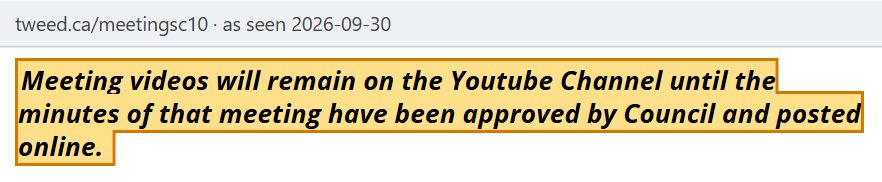
"Meeting videos will remain on the Youtube Channel until the minutes of that meeting have been approved by Council and posted online."
The town’s Meetings page as we saw it on September 30, 2026. Tap to open it full size.
On September 30, 2026 the channel had 54 council, special and budget meeting videos from June 25, 2024 onward, including every regular council meeting, and none of the 2023 regular meetings.
Every year an outside auditor checks the town’s books, and the town posts the result. Tweed’s records portal has the audited statements for 2009 to 2023. The 2023 ones were signed in May 2024. We could not find the 2024 statements, more than a year later. Staff told council in September 2026 that the 2025 statements should be done by the end of October.
Why it matters
The audited statements are the most trustworthy picture of the town’s money: an independent accountant has checked them. Ontario law asks towns to publish them once they are ready. Without them, residents rely on the budget and on the yearly report to the Province, which no auditor signs.
It could be because…
The 2024 audit may have taken longer than usual. New accounting rules have slowed audits for many Ontario towns.
The statements may have been presented to council and posted somewhere we did not look.
Questions you could ask
Has the 2024 audit been finished, and when will the statements be posted?
Once the 2025 statements are finished in October, will both years be posted where residents can find them?
Did the auditor raise any concerns in a management letter, and will council make it public?
You can ask during the public part of a council meeting, by writing to the clerk, or by contacting your councillors. How to reach council.
Speak for Tweed?Send us your answer and we will publish it with this question.
The evidence
The "Financial Reports" link on the town’s website opens a records portal folder with 15 documents: financial statements for 2009 to 2023, and nothing later, when we looked on September 30, 2026.
On September 29, 2026 the treasurer told council the auditors had begun preliminary work on the 2025 audit, and that the 2025 Financial Information Return and financial statements should be finished before the end of October. The target had been July; the report says the delay was due to workload.
Tweed posts its open tenders on a "Tender Opportunities" page, and says it also buys through two purchasing groups shared with other towns. What we could not find is a record of past tenders: who bid, who won, and for how much. Some awards appear in council minutes, but mostly the bigger ones, and they are hard to find.
Why it matters
A simple list of contracts (what, who, how much, and whether it was tendered) is the best tool residents have for spotting favouritism, contracts split to avoid tendering, or overpaying. Posting open tenders is a good start; publishing the results finishes the job.
It could be because…
Many small purchases are made by phone or email quotes, which are not published anywhere.
Purchases through the shared buying groups are awarded by those groups, not by the town.
The town may publish awards somewhere we did not find.
Questions you could ask
Where are past tenders and their results (bidders, winner, amount) published?
Will the town publish a yearly list of every purchase over $10,000, with the supplier, amount and how it was chosen?
You can ask during the public part of a council meeting, by writing to the clerk, or by contacting your councillors. How to reach council.
Speak for Tweed?Send us your answer and we will publish it with this question.
The records that would answer this can be requested: Contracts awarded, and how, with wording you can copy.
The evidence
The "Tender Opportunities" page listed an open request for quotes for winter maintenance, and named Local Authority Services (LAS) and Canoe Procurement Group as shared buying groups. It lists no past tenders or winners.
In 2019, Tweed had $4.3M more in cash and money owed to it than it owed to others. By 2024 it was −$11.2M. About 53% of that change ($8.2M) is a new accounting rule from 2023: towns must now record the future cost of closing things like a landfill. That is not new spending or borrowing. Even leaving that out, only 7 of 73 similar towns are in a weaker position.
Tweed went from having money in the bank to owing more than it has. What changed?
−$15M−$10M−$5.0M$0$5.0M
−$11.2M
201920202021202220232024
Show as a table
Year
Net financial position
2019
$4.3M
2020
$3.8M
2021
$1.2M
2022
$138K
2023
−$11.6M
2024
−$11.2M
Why it matters
This number is one of the clearest signs of whether a town is living within its means. The accounting-rule part is a bill that will come due when the landfill closes, not money already spent. The rest is real borrowing and spending of savings.
It could be because…
A new accounting rule (asset retirement obligations, from 2023) added a large future cost to the books all at once.
Borrowing for a planned project, such as sewage lagoons, which is paid back over many years.
Questions you could ask
What is the plan and timeline for paying the landfill closing cost?
Without the accounting change, is the town's position getting better or worse?
You can ask during the public part of a council meeting, by writing to the clerk, or by contacting your councillors. How to reach council.
Speak for Tweed?Send us your answer and we will publish it with this question.
Tweed spent about $369 per home on garbage, dump and recycling in 2024. The typical similar town spent $210. Only 8 of 73 similar towns spent more.
Why it matters
Spending more than neighbours is not wrong by itself. It might buy better service. But it is the first place to look for costs that could be lower, such as contracts that were not competitively bid.
It could be because…
Geography: more roads, more snow, a bigger area or a landfill of its own.
Accounting: some towns record the same cost in a different category.
A one-time cost in this year.
Questions you could ask
What makes this cost higher here than in similar towns?
When were the main contracts in this area last put out to competitive tender?
You can ask during the public part of a council meeting, by writing to the clerk, or by contacting your councillors. How to reach council.
Speak for Tweed?Send us your answer and we will publish it with this question.
The evidence
Garbage, dump and recycling per home: Tweed $369; typical similar town $210; ranked 9th highest of 74.
Can we count your visit? With your OK, we use Google Analytics to see which pages help people. It sets cookies and sends visit data to Google. Nothing loads unless you say yes. Privacy